


Tests of heat-shielding materials in a high-temperature gas flow
COUNTRY OF ORIGIN
BelarusIDENTIFIER
BO6983PUBLISHED
2026-06-05LAST UPDATE
2026-06-07DEADLINE
Linked profile in other language
Responsible
Svetlana Markova
+375 29 752 8328
sveta_oms@itmo.by
+375 29 752 8328
sveta_oms@itmo.by
Summary
A.V.Luikov Institute Heat and Mass Transfer of the NAS of Belarus offers consumers services for testing of heat-shielding materials in a high-temperature gas flow under an outsourcing agreement or subcontracting is looking for partners interested in a distribution services agreement.
Description
Thermal protection material (TPM) testing methods are divided into two main categories: gas-dynamic (high-temperature) tests, which simulate real-world extreme conditions and laboratory thermophysical methods, which determine the properties of the material. High-temperature and gas-dynamic tests verify the performance of TPMs under conditions close to natural ones:
Plasmatron tests. The sample is placed in a high-temperature plasma flow to study heating and ablation (mass loss).
Radiation heating. Heating the material surface with powerful lasers or infrared emitters without exposure to an airflow.
Gas-dynamic (in wind tunnels).
A.V.Luikov Institute of Heat and Mass Transfer of the NAS of Belarus created research methods, equipment and experimental stands for testing materials using plasma torches generating gas flows with parameters simulating the natural conditions of space flights.
Experimental stands have an open architecture, which allows you to equip the experiment with various devices based on the tasks. The tests include experimental and computational diagnostics (gas-dynamic, optical) of plasma flows, diagnostics of their interaction with materials of various classes, analysis of the results and substantiation of recommendations for improving the properties of heat-shielding materials (HSM).
Plasmatron "EDPG" with a nozzle and an ins ert for testing HSM samples for shear stresses.
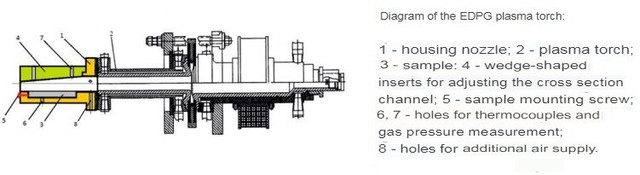
An experimental stand based on a coaxial electric arc gas heater is designed to test the thermal protection of materials or nozzle inserts at temperatures of 3000–4000 K, supersonic speeds of the working fluid outflow and high values of gas flow stagnation pressure.
Specifications of coaxial gas heater:
Stand LUCH-2
The main element of the Luch-2 stand is a combined electric arc gas heater of a linear circuit - an EDPG-1.2 plasma torch with gas-dynamic and magnetic stabilization of the arc discharge. The process of HSM ablation at the Luch-2 stand is recorded by a video camera and a signal recorder with data recording on a computer.
Technical characteristics of the stand Luch-2:
An experimental bench based on a linear plasma torch "EDPG" with gas-dynamic stabilization of an arc discharge with a power of up to 500 kW, equipped with a system for supplying a dispersed phase (Al2O3, SiO2, and other particles) in to the plasma flow, allows testing HSM in heterogeneous flows at a thermal load of up to 107 W/ m2.
The stand provides a thermal load on the material under study of up to 107 W/m2.
Information about electric arc plasma torches is available on the Institute's website here.
Plasmatron tests. The sample is placed in a high-temperature plasma flow to study heating and ablation (mass loss).
Radiation heating. Heating the material surface with powerful lasers or infrared emitters without exposure to an airflow.
Gas-dynamic (in wind tunnels).
A.V.Luikov Institute of Heat and Mass Transfer of the NAS of Belarus created research methods, equipment and experimental stands for testing materials using plasma torches generating gas flows with parameters simulating the natural conditions of space flights.
Experimental stands have an open architecture, which allows you to equip the experiment with various devices based on the tasks. The tests include experimental and computational diagnostics (gas-dynamic, optical) of plasma flows, diagnostics of their interaction with materials of various classes, analysis of the results and substantiation of recommendations for improving the properties of heat-shielding materials (HSM).
Plasmatron "EDPG" with a nozzle and an ins ert for testing HSM samples for shear stresses.
An experimental stand based on a coaxial electric arc gas heater is designed to test the thermal protection of materials or nozzle inserts at temperatures of 3000–4000 K, supersonic speeds of the working fluid outflow and high values of gas flow stagnation pressure.
Specifications of coaxial gas heater:
| electric power | 500-700 kW |
| working gas flow | up to 0.12 kg/s |
| enthalpy of gas flow | 3.5–5.5 MJ/kg |
| pressure in the discharge chamber: | |
| when testing bushings | up to 60 atm. |
| when testing cylinders up to 20 mm in diameter | up to 25 atm. |
Stand LUCH-2
The main element of the Luch-2 stand is a combined electric arc gas heater of a linear circuit - an EDPG-1.2 plasma torch with gas-dynamic and magnetic stabilization of the arc discharge. The process of HSM ablation at the Luch-2 stand is recorded by a video camera and a signal recorder with data recording on a computer.
Technical characteristics of the stand Luch-2:
| electric power | 1000-1500 kW |
| working gas flow | up to 120х10-3 kg/s |
| gas pressure in the discharge chamber | up to 30х105 N/m2 |
| heat flow | up to 4 kW/cm2 |
| braking pressure | up to 8 atm. |
| flow rate | M≈3,5–4 |
| sample feed rate during testing | 4х10-3 m/s |
An experimental bench based on a linear plasma torch "EDPG" with gas-dynamic stabilization of an arc discharge with a power of up to 500 kW, equipped with a system for supplying a dispersed phase (Al2O3, SiO2, and other particles) in to the plasma flow, allows testing HSM in heterogeneous flows at a thermal load of up to 107 W/ m2.
The stand provides a thermal load on the material under study of up to 107 W/m2.
Information about electric arc plasma torches is available on the Institute's website here.
Advantages and Innovations
Experimental stands have an open architecture, which allows you to equip experiments with various devices based on the tasks.
The stands are created using modern technological equipment and the latest measuring equipment.
Highly qualified personnel.
The stands are created using modern technological equipment and the latest measuring equipment.
Highly qualified personnel.
Stage of development
Already on the market
Funding source
State budged
Internal
Internal
IPR status
Exclusive rights
Secret know-how
Secret know-how
Comments regarding IPS status
The equipment and methods are unique, created in single copies to obtain data on the properties of the objects under study.
Sector group
Aeronautics, Space and Dual-Use Technologies
BioChemTech
Intelligent Energy
Materials
BioChemTech
Intelligent Energy
Materials
Client information
Type
R&D institution
Year established
1952
NACE keywords
M.72.19 - Other research and experimental development on natural sciences and engineering
M.74.90 - Other professional, scientific and technical activities n.e.c.
C.27.90 - Manufacture of other electrical equipment
C.32.99 - Other manufacturing n.e.c.
M.74.90 - Other professional, scientific and technical activities n.e.c.
C.27.90 - Manufacture of other electrical equipment
C.32.99 - Other manufacturing n.e.c.
Turnover (in EUR)
10-20M
Already engaged in transnational cooperation
Yes
Additional comments
The A.V. Lykov Institute of Heat and Mass Transfer of the National Academy of Sciences of Belarus is the country's largest scientific institution, focusing on fundamental and applied problems of heat and mass transfer, fluid dynamics, energy, thermal engineering, chemical physics, combustion and explosion physics, and nanotechnology. It also develops energy-efficient and environmentally friendly technologies and equipment, as well as apparatus and instruments for power engineering and mechanical engineering, the agro-industrial complex and construction industries, medicine, the chemical, electronics, radio engineering, food, and space industries.
Main areas of scientific and technical activity:
- heat and mass transfer processes in capillary-porous bodies, dispersed systems, rheological and turbulent media, nonequilibrium flows, low-temperature plasma, and radiation-matter interactions;
- dynamics, transport, and elementary processes in systems with chemical and phase transformations;
- Physical kinetics, heat transfer, and transport processes at the micro- and nanoscale;
- Energy-efficient heat and mass transfer technologies, equipment, and apparatus;
- Transport processes, heat transfer in biological systems and complex molecules;
- Physical and structural properties of substances, materials, and surfaces under internal structuring and extreme conditions;
- Mechanics of fluids, gases, and plasma;
- Mechanics and rheology of viscoelastic media under shear, temperature, and electromagnetic influences;
- Numerical methods and software packages for the numerical modeling of physicochemical and heat transfer processes;
- Catalytic technologies and equipment for producing hydrogen, synthesis, endo-, and exo-gases, synthetic and composite fuels;
- Technologies and equipment for producing nano- and microstructures and materials;
- Plasma, plasma-chemical, and chemical methods of waste purification and disposal.
The Institute organizes:
Minsk International Forum on Heat and Mass Transfer;
International Conference "Heat Pipes, Heat Pumps, Refrigerators, and New Energy Sources";
International Conference "Methodological Aspects of Scanning Probe Microscopy";
Minsk International Colloquium on the Physics of Shock Waves, Combustion, and Detonation;
The Institute hosts the editorial board of the Engineering Physics Journal, which is republished in English by Springer.
The Institute maintains scientific, scientific-organizational, and scientific-industrial cooperation with academic and industry research institutes, universities, design bureaus, associations, and enterprises in Belarus, Russia, Ukraine, Kazakhstan, Moldova, Uzbekistan, Lithuania, Latvia, China, the USA, India, Germany, Poland, the Czech Republic, Israel, Brazil, Italy, France, and other countries.
Official website of the A.V. Lykov of Heat and Mass Transfer Institute.
Main areas of scientific and technical activity:
- heat and mass transfer processes in capillary-porous bodies, dispersed systems, rheological and turbulent media, nonequilibrium flows, low-temperature plasma, and radiation-matter interactions;
- dynamics, transport, and elementary processes in systems with chemical and phase transformations;
- Physical kinetics, heat transfer, and transport processes at the micro- and nanoscale;
- Energy-efficient heat and mass transfer technologies, equipment, and apparatus;
- Transport processes, heat transfer in biological systems and complex molecules;
- Physical and structural properties of substances, materials, and surfaces under internal structuring and extreme conditions;
- Mechanics of fluids, gases, and plasma;
- Mechanics and rheology of viscoelastic media under shear, temperature, and electromagnetic influences;
- Numerical methods and software packages for the numerical modeling of physicochemical and heat transfer processes;
- Catalytic technologies and equipment for producing hydrogen, synthesis, endo-, and exo-gases, synthetic and composite fuels;
- Technologies and equipment for producing nano- and microstructures and materials;
- Plasma, plasma-chemical, and chemical methods of waste purification and disposal.
The Institute organizes:
Minsk International Forum on Heat and Mass Transfer;
International Conference "Heat Pipes, Heat Pumps, Refrigerators, and New Energy Sources";
International Conference "Methodological Aspects of Scanning Probe Microscopy";
Minsk International Colloquium on the Physics of Shock Waves, Combustion, and Detonation;
The Institute hosts the editorial board of the Engineering Physics Journal, which is republished in English by Springer.
The Institute maintains scientific, scientific-organizational, and scientific-industrial cooperation with academic and industry research institutes, universities, design bureaus, associations, and enterprises in Belarus, Russia, Ukraine, Kazakhstan, Moldova, Uzbekistan, Lithuania, Latvia, China, the USA, India, Germany, Poland, the Czech Republic, Israel, Brazil, Italy, France, and other countries.
Official website of the A.V. Lykov of Heat and Mass Transfer Institute.
Languages spoken
English
Russian
Russian
Information about partnership
Type of partnership considered
Distribution services agreement
Outsourcing agreement
Subcontracting
Outsourcing agreement
Subcontracting
Type and role of partner sought
Consumers interested in services for testing of heat-shielding materials in a high-temperature gas flow under an outsourcing agreement or subcontracting.
Partners interested in purchasing services for testing thermal protection materials in high-temperature gas flow based on a distribution services agreement.
Partners interested in purchasing services for testing thermal protection materials in high-temperature gas flow based on a distribution services agreement.
Type and size of partner sought
> 500
251-500
SME 51-250
SME 11-50
SME <= 10
R&D Institution
University
Sole proprietor
251-500
SME 51-250
SME 11-50
SME <= 10
R&D Institution
University
Sole proprietor
Attachments

Views: 392
Statistics since 05.06.2026 14:57:46
Statistics since 05.06.2026 14:57:46